

 English
 Italian
 Spanish
 Japanese
 Swedish
 Portuguese
 Lithuanian
 Dutch
 Korean
 Russian
 French
 German
 Arabic
85 cm Bust and 64 cm Waist: Understanding Female Half-Figure Model Proportions
A mannequin's proportions influence how garments look long before a customer considers their color, fabric, or design. When the bust is too wide or the waist shape does not correspond to the intended garment silhouette, clothing may appear stretched, loose, or poorly balanced. For retailers and visual merchandising teams, understanding these measurements is an important part of selecting display equipment.
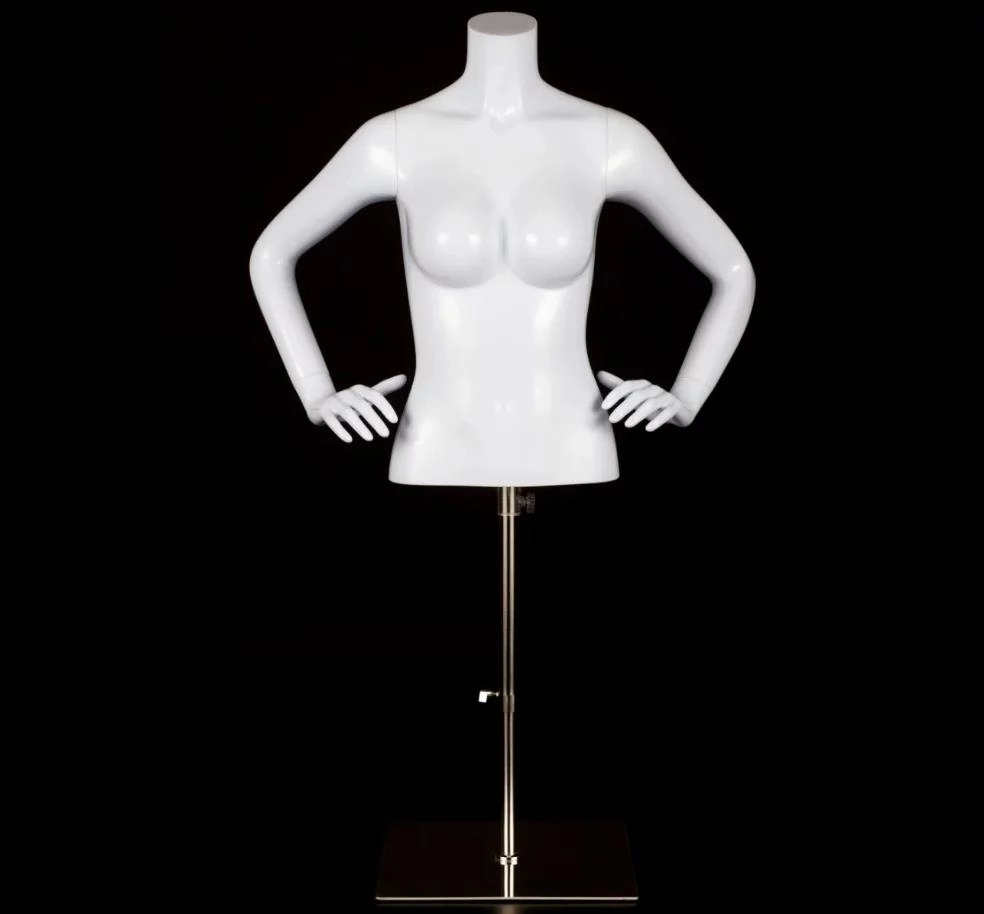
The Female half-figure model (supporting structure) from Posh Concept Mannequins provides a defined set of dimensions for planning women's apparel presentations. With an 85 cm bust, a 64 cm waist, and an overall height of 63 cm, this model offers a compact upper-body form for displaying garments where torso proportions and presentation space both matter.
Rather than looking at bust and waist measurements separately, it is more useful to consider how they work together, which clothing styles they can accommodate, and how the model fits into a retail display arrangement.
Understanding the 85 cm Bust and 64 cm Waist
Bust and waist measurements provide two important reference points when evaluating a female half-figure model. The bust measurement indicates the circumference of the upper torso, while the waist measurement describes the narrower section below it.
For this model, the specifications are:
| Measurement | Centimeters | Inches |
|---|---|---|
| Overall Height | 63 cm | 24.8 in |
| Bust | 85 cm | 33.46 in |
| Waist | 64 cm | 25.2 in |
| Material | PC | PC |
The difference between the bust and waist measurements is 21 cm. This creates a noticeable transition from the fuller upper torso to the narrower waist area, providing a reference silhouette for garments designed with a defined waistline.
For example, fitted tops, tailored shirts, and lightweight blouses can be evaluated according to how their fabric sits across the bust and follows the waist. Garments with darts, shaping seams, or waist-contouring details may also benefit from a display form with clearly defined upper-body proportions.
However, these measurements should not be interpreted as a universal clothing size. Garment patterns vary between brands, and factors such as fabric elasticity, cut, seam placement, and intended fit all influence how a garment sits on a mannequin.
How Bust-to-Waist Proportions Affect Garment Presentation
A mannequin does more than hold clothing in position. Its shape provides the underlying structure that determines how a garment is visually presented.
An 85 cm bust offers a specific reference for evaluating the fit of women's upper-body garments. When displaying a shirt or blouse, the shoulder and bust areas should sit naturally without excessive pulling across the front. Buttons should remain reasonably aligned, and the fabric should not form unnecessary horizontal tension lines.
The 64 cm waist provides another reference point. For garments with shaped side seams or fitted waist sections, the transition between the bust and waist can influence the appearance of the overall silhouette.
Several garment details are worth checking during styling:
Bust darts: Check whether the dart points and shaping seams sit in the intended positions.
Side seams: Observe whether the seams follow the torso without twisting or pulling.
Waist shaping: Check how fitted sections follow the narrower waist area.
Hem alignment: Make sure the garment hangs evenly rather than shifting to one side.
Fabric tension: Look for excessive stretching, particularly around buttons, seams, and closures.
The female half-figure model can therefore serve as a practical reference when preparing different women's apparel collections. It allows merchandising teams to assess how garment construction details appear on a consistent torso shape instead of relying entirely on flat garment photography.
Why the 63 cm Overall Height Matters in Display Planning
The overall height of a half-figure model affects how it can be incorporated into a retail environment. At 63 cm (24.8 inches), this model has a compact vertical dimension that can be considered when arranging countertop displays, product presentation tables, and dedicated apparel fixtures.
Before selecting a display location, retailers should consider the available vertical clearance. This includes the height of the supporting fixture, the mannequin itself, and the additional space required for the garment being displayed.
For example, a long-sleeved shirt, jacket, or layered outfit may extend beyond the mannequin's own dimensions. The final display height should therefore account for the complete garment rather than the model alone.
A few practical considerations can help avoid display problems:
Measure the available height between the display surface and any overhead shelves or fixtures.
Allow sufficient clearance for collars, shoulders, and garment details.
Consider the viewing angle from normal customer walking positions.
Check whether nearby merchandise blocks the visibility of the displayed outfit.
Keep enough space around the model for customers to recognize the garment's overall shape.
For smaller retail areas, the 63 cm height provides a useful starting point when planning compact upper-body presentations. It is particularly relevant when a store wants to highlight a specific garment category without dedicating the entire display area to a full-body mannequin.
PC Material and Its Role in Mannequin Manufacturing
Material selection is another consideration when comparing mannequin products. This model is manufactured from PC, or polycarbonate, a thermoplastic material used in a range of engineered products.
In mannequin manufacturing, material properties influence the production process, product structure, surface appearance, and potential applications. PC is particularly relevant to Posh Concept Mannequins because the company introduced PC mannequins as one of its early sustainable display solutions.
In 2012, Posh began applying blow molding technology to retail mannequins. This manufacturing approach became an important part of the company's product development, helping establish its early position in the sustainable mannequin market.
Over time, the company's material development expanded beyond PC to include PP, PE, and ABS. These developments reflect a broader approach to matching material systems with different retail display requirements.
For buyers evaluating a PC mannequin, several points deserve attention:
Material consistency: Check whether the material is suitable for the intended production and display requirements.
Surface quality: Examine the visible finish under the lighting conditions used in the store.
Structural suitability: Confirm that the model's construction meets the requirements of its intended application.
Manufacturing process: Understand how the material and forming method influence the finished product.
Product specifications: Verify dimensions and material details before confirming an order.
The PC female half-figure model combines a defined set of torso measurements with a material selected for the product's manufacturing requirements. Buyers should still evaluate the actual finish and construction according to their own merchandising standards.
Matching the Model with Different Women's Apparel Categories
Not every garment requires the same mannequin proportions. A loose-fitting top, a structured jacket, and a fitted blouse each present different styling considerations.
The 85 cm bust and 64 cm waist of this model provide a consistent reference for preparing upper-body apparel displays.
For fitted shirts, attention should be given to the relationship between the bust area and waist shaping. The garment should follow the torso without creating excessive tension or unwanted folds.
For casual tops, such as relaxed-fit T-shirts, the focus may be more on shoulder placement, neckline appearance, and how the fabric falls from the bust. A garment that is intentionally loose should retain its intended shape rather than appearing unnecessarily stretched.
For lightweight jackets and structured outerwear, the front opening, lapel position, and shoulder alignment deserve closer attention. The waist measurement can also help retailers assess how shaped jackets appear when displayed from the front.
When preparing a collection, merchandising teams can use the same model to compare several garments under consistent display conditions. This makes differences in cut, fabric behavior, and garment construction easier to observe.
The Supporting Structure and Practical Display Setup
A half-figure model is only one part of a complete display arrangement. Its supporting structure and the fixture used to position it should be considered together.
Before installation, buyers should confirm how the model is intended to be supported and whether the selected display fixture is compatible with its construction. The supporting arrangement should keep the model appropriately positioned during normal retail use.
It is also important to consider the weight and shape of the garments being displayed. A lightweight blouse and a heavier jacket place different demands on a display setup. The supporting arrangement should be suitable for the intended styling application.
For retail teams, a practical inspection should include:
Checking the compatibility of the supporting structure with the display fixture.
Confirming that the model maintains its intended position.
Inspecting the connection points before styling.
Making sure garments can be dressed and removed without unnecessary handling difficulty.
Reviewing the complete setup after installation.
The purpose is not simply to position a mannequin upright. It is to create a repeatable display arrangement that allows garments to be presented consistently throughout a merchandising cycle.
Posh Concept Mannequins: Manufacturing Experience and Material Development
Selecting a mannequin supplier involves more than comparing product dimensions. Manufacturing experience, material development, customization capabilities, and production consistency can all influence long-term purchasing decisions.
Posh Concept Mannequins (SHANGMEI) was established in 2012, backed by the engineering and manufacturing heritage of Cosmos Machinery Group, which brings more than 60 years of industrial experience.
The company initially introduced PC mannequins through blow molding technology and gradually expanded its material systems to include PP, PE, and ABS. Its development also includes the introduction of ocean-recycled PP materials in 2023 and continued exploration of recycled and lower-impact materials in 2025.
Posh has developed partnerships with international retail brands over the years. Its cooperation history includes H&M in 2015, Decathlon in 2018, BONAMI in 2019, and adidas in 2022. These milestones reflect the company's ongoing participation in international retail display projects.
Its manufacturing capabilities are supported by three main foundations:
Engineering heritage: More than 60 years of manufacturing experience through its connection with Cosmos Machinery Group.
Owned manufacturing base: A 10,000 m² production facility with more than 100 professionals and a dedicated engineering team.
Global production capacity: More than 5,000 mannequins produced monthly, with products exported to over 30 countries and regions.
The company also continues to upgrade its manufacturing systems. In 2024, it advanced digitalization and intelligent manufacturing, followed by the introduction of new-generation cast aluminum formwork technology in 2026. These developments support its efforts to improve production efficiency, customization accessibility, and product consistency.
For buyers sourcing a specific mannequin configuration, working with a manufacturer that understands both material systems and retail display requirements can make product communication and specification confirmation more straightforward.
What Buyers Should Confirm Before Ordering
Before purchasing a female half-figure model, buyers should compare the product specifications with their intended garments and display arrangements.
For this model, the key reference points are its PC material, 63 cm overall height, 85 cm bust, and 64 cm waist. These figures should be checked against the apparel categories and display fixtures planned for use.
It is also useful to clarify several details during the purchasing process:
Measurement requirements: Confirm that the bust, waist, and overall height match the intended display proportions.
Material specifications: Verify that PC is the required material for the project.
Surface finish: Discuss the expected appearance and finish for the selected mannequin range.
Supporting arrangement: Confirm the compatible supporting structure and installation requirements.
Garment applications: Identify whether the model will primarily display fitted tops, casual apparel, or structured garments.
Order consistency: For multiple units, confirm that the same dimensions and finish specifications will be maintained.
These checks help reduce misunderstandings between product selection, manufacturing, and final retail installation.
A Defined Torso Shape for Consistent Apparel Display
A female half-figure model should be selected according to more than its general appearance. Bust and waist measurements influence how clothing sits, while overall height affects how the model fits into the retail environment.
With an 85 cm bust, a 64 cm waist, and a 63 cm overall height, the Female half-figure model (supporting structure) provides clear dimensional references for women's upper-body apparel presentation. Its PC material and position within the Solid-Color Mannequins range also make it a specific option for buyers comparing mannequin materials and product configurations.
For retailers, the practical value lies in matching these specifications with actual garment cuts, display fixtures, and merchandising objectives. For sourcing teams, confirming dimensions, material, and supporting requirements before ordering helps establish clearer expectations.
With its experience in mannequin engineering, material development, and global retail manufacturing, Posh Concept Mannequins continues to develop display solutions around the changing requirements of fashion retail.
When consistent proportions and practical display planning matter, choosing a mannequin with clearly defined specifications is a useful starting point.